



Rwandan Ibis
- Regular price
-
410.00TL - Regular price
-
- Sale price
-
410.00TL
Couldn't load pickup availability
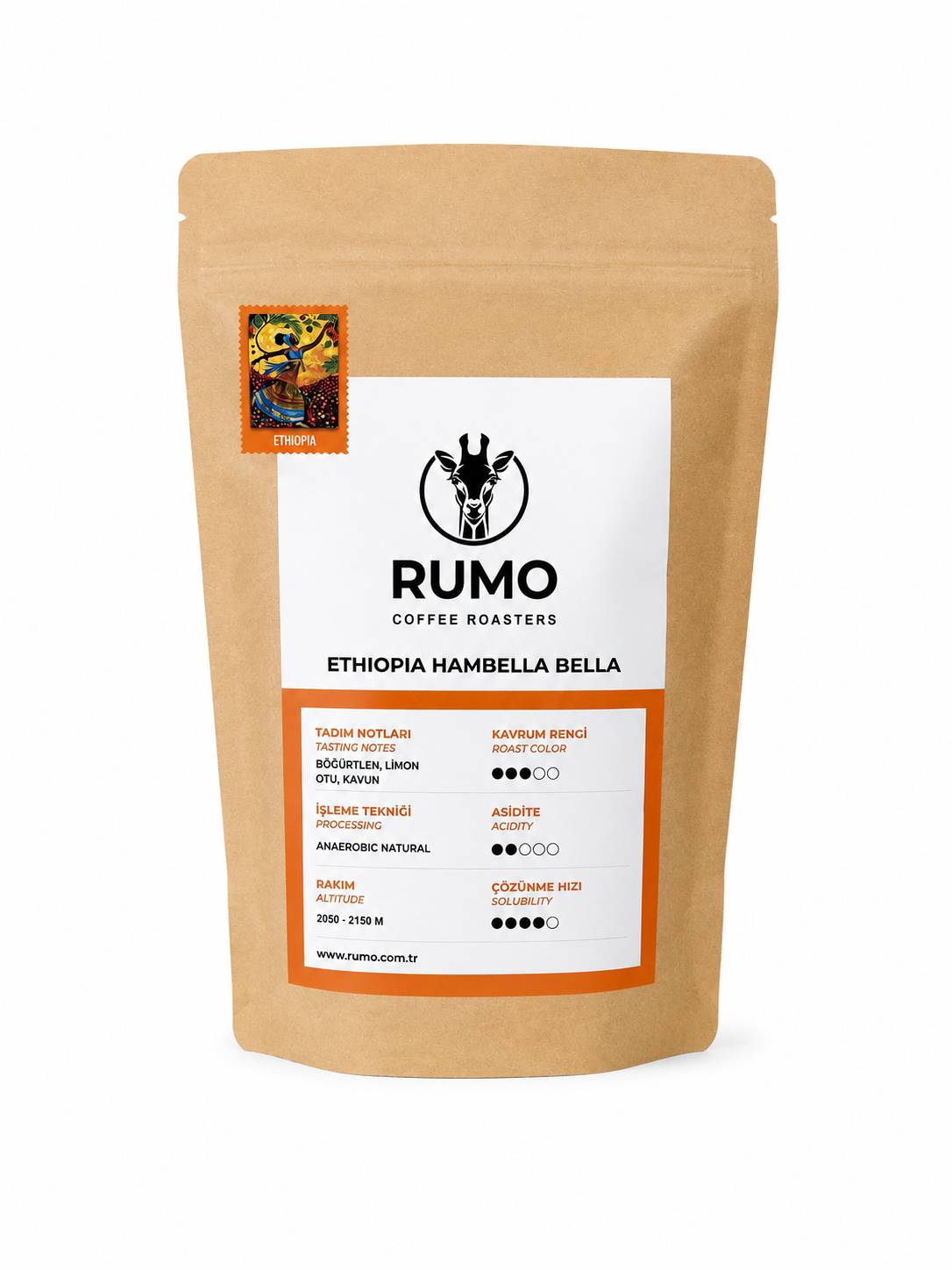

The roast level of coffee is entirely a personal preference. This preference is shaped especially by your palate, past experiences, and the region you live in.
First of all, let's state that coffee is a fruit, containing complex flavors and acidity. Despite this, during the roasting process, we can change this situation based on our preferences. The roasting process is a complex one.
Coffee goes through certain stages during roasting. The most important of these stages is the first crack stage, where the coffee becomes drinkable. At this stage, the moisture in the coffee evaporates, and the trapped steam creates pressure within the bean. The hard structure of the bean cannot withstand this pressure and expands, causing it to crack. A "cracking" sound is heard at this stage. The time elapsed after this sound determines the roast level of the coffee.
1. Light Roast
When the first crack begins, the roaster removes the coffee at a determined time and temperature without waiting for the popping to finish, and puts it to cool.
Light roast offers you the following:
· Flavor notes can be clearly perceived,
· Despite its light body, sweetness is abundant,
· It clearly reflects its regional character and terroir,
· It has a vibrant acidity.
Disadvantages: It is more prone to brewing errors. If the coffee is under-extracted or over-extracted, its taste will be sharp. If you don't have a quality coffee grinder, grinding can be difficult. If you are preparing espresso-based coffees, channeling risk is higher due to the hard structure of the beans, and acidity can become much more pronounced and disturbing. The gas release waiting period, which we call "degassing", is also longer compared to others. (Average 15 days)
2. Medium Roast
The most important difference between medium roast and light roast is that the coffee beans are removed after the first crack finishes.
Medium roast promises you the following:
· Flavor notes intensify and blend,
· It has low acidity,
· Its body (mouthfeel) is more intense.
· It is more balanced in Turkish coffee, espresso, and moka pot brewing methods,
· In high-pressure brewing methods like espresso, the risk of channeling is low. Brewing is easier,
· The gas release period is approximately 10 days.
· Automatic coffee machines with built-in grinders are not strained.
Disadvantages: Flavor notes and terroir characteristics are difficult to perceive. In filter coffee brewing, due to low acidity, it loses its vibrancy. Perceived sweetness is less compared to light roast. It reduces the potential of high-scoring specialty coffees.
3. Medium Dark Roast
While the roast profile is generally the same as medium, it is given a little more time for development.
Medium dark roast promises you the following:
· The coffee flavor is more intense,
· Only nuanced differences are felt between coffees,
· The mouthfeel is more intense compared to medium roast,
· Acidity is so low that it is barely felt in all brewing methods,
· If you are new to the world of espresso-based coffee, it is easier to prepare,
· It pairs very well with milky beverages; the coffee taste is more pronounced,
· The gas release period is approximately 7 days,
· It yields very successful results in entry-level coffee machines,
· More balanced coffees are prepared with low alkalinity household filtered water.
Disadvantages: The flavor notes are almost completely masked. In filter brewing, due to low acidity, the vibrancy of the coffee decreases. Perceived sweetness levels are lower compared to medium roast.
4. Dark Roast
Roasted longer than medium dark, the roasting is stopped immediately after the second crack is heard. The second crack is a structural crack. It follows the same logic as the crackling of burning wood on a fire.
Dark roast promises you the following:
· The classic coffee taste is at its most intense,
· Acidity is not felt,
· The difference between coffees is almost non-existent,
· Since coffee beans soften significantly, the gas release period is short,
· It is the preferred roast type by industrial producers due to the standardization it provides.
Disadvantages: Organic acids and complex aromatics are damaged. Therefore, regardless of the brewing method, bitter and harsh tastes are perceived. It stales quickly. In espresso, crema appears more abundant but its quality decreases. It covers up the flaws of coffee, making even low-quality coffee palatable.
Which Coffee Roast Should You Prefer?
Those who want to discover the flavor notes of coffee; understand regional and varietal differences, and consume a special filter coffee with natural acidity, should prefer a light roast. This roast is an excellent choice especially for those who want to explore the world of specialty coffee.
If you don't mind the flavor notes intensifying and blending, if you are looking for more full-bodied coffees, if you expect coffee to tolerate brewing errors, if you don't like pronounced acidity in filter coffee, and if you prefer a light acidity in espresso-based coffees, then medium roast is for you. Also, if you enjoy plain coffee and use an automatic coffee machine, a medium roast will satisfy you. In Rumo, you can find these coffees under the headings intense filter coffee and espresso.
If flavor notes are not important to you, and you are looking for a full-bodied coffee with low acidity and sufficient nuanced differences, then you should choose medium dark. This coffee is quite easy to brew in automatic coffee machines and entry-level espresso machines. If you love espresso but don't want bitter tastes, and you adore milky coffees, you should try medium dark coffees. In Rumo, Savanna Black perfectly meets these criteria.
If bitter, woody, and smoky flavors don't bother you, and you want an intense and oily mouthfeel along with a long aftertaste, you should try a dark roast. This is already used in industrial coffees. Therefore, it is a type of roast you will not find in Rumo.

Coffee Information
Tasting Notes
Red Fruits, Milk, Roasted Peanuts
Tasting Score:
85.75
Processing Technique:
Natural
Area:
Southern Province Huye
Altitude:
1900 M
Variety:
Red Bourbon
Harvest:
2023 - 2024
Manufacturer:
Bernard Uwitije
Supplier:
Nordic Approach by Malkins
Ibisi Mountain Hills Wash Station is located in the hills of Southern Rwanda, a short drive from Nyungwe Forest, from which one of the tributaries of the Nile comes from the east side.
Bernard Uwitije, a native of the region, was trading unwashed Ordinary coffee until 2015, when he realised the potential of fully washed specialty grade coffee.
He established his first washing station, Gitega Hills, and it was successfully operational in its first year and decided to expand operations by establishing a second washing station, Ibisi, and the quality at both stations continues to be exceptional.
Ibisi produced around 790 tonnes in 2018 and they work with over 2000 farmers, 845 of whom are part of 25 groups whose farms are certified to CAFE Practices, 45% of whom are women.
After removing the pulp from freshly delivered cherries, the coffee is wet fermented and then the beans are sorted according to their density using water-filled sorting channels. The wet parchment is dried under cover for 24 hours before being moved to uncovered drying beds for an average of 15 days. During this time, the coffee is continuously sorted by hand.
A portion of the income generated by the station after repayment of loans each year is given to farmers as premiums to support our 2000 farming communities to provide health insurance, pay their children’s school fees and sometimes improve their homes and lifestyles.
Brewing Recipes
Our Favorite Brewing Methods;
Water preference: Iceberg
V60
Grind Size: Medium 450 µm
Water temperature: 93
Coffee: 15 gr
Water: 250 gr
You can attach the filter to the dripper with tap water, but I recommend preheating the dripper with hot water, even if it's just a little.
00:00 - 00:08 50 gr blooming
00:30 - 00:50 complete to 150
01:20 - 01:40 complete to 250
Total brewing time is approximately between 2:20 - 2:40.
Aeropress
Tim Wendelboe's recipe works very well with our coffees. You don't need a gooseneck kettle. The brewing time is very short. We especially recommend it to those who want to drink rich and delicious coffee practically at work and while traveling.
Grind Size: Medium Fine 300 µm
Water temperature: 96 (For a classic kettle, it's enough to wait 1 minute after the water stops boiling and opening the kettle lid.)
Coffee: 14 gr
Water: 200 gr
Aeropress standard method:
00:00 - 00:10 Fill with 200 gr water, stir back and forth 3 times and quickly close the plunger.
01:00 - 01:08 Remove the plunger, stir back and forth 3 times and close it.
01:08 - 01:30 Start pressing and complete brewing within 20-25 seconds.
French Press
Our first recommendation for those who ask what is the most practical and economical way to brew our coffees is the French press. It's not as clear as coffees brewed with a paper filter, but it's surprisingly successful.
Grind size: Medium Coarse 550 µm
Water temperature: 96 (For a classic kettle, it's enough to wait 1 minute after the water stops boiling and opening the kettle lid.)
Coffee: 16gr
Water: 250 gr
00:00 - 00:10 pour all the water
00:10 - 00:30 stir for 20 seconds. (Please try not to stir too fast and create a vortex) Close the lid and wait.
04:00 - 04:20 open the lid, stir calmly for 20 seconds and close.
07:00 - 08:00 Slowly press and complete brewing.
Sage Sdc 450
For 30 gr to 500ml or 40 to 650ml brews ;
Grind Size: 450 µm for 500 ml - 500 µm for 650 ml
Bloom time: 45 sec
Bloom vol: 3 lines for 650 - 4 lines for 500 ml
Brew temp: 94
Flow rate: Two lines
For 500 ml, the brew should completely drain into the carafe in 4 minutes, and for 650 ml, in 5 minutes.